Showing posts with label Constitution. Show all posts

Thursday, October 30, 2014

Teaching about slavery BEFORE the Missouri Compromise

Scroll to the bottom of this post for some new resources that are available since I wrote this post.

I do not have any specific data on this, but I would bet a lot of money that if you went into middle and high school classrooms and asked students about slavery in the North, you would get a lot of blank stares. I would also bet that many history teachers (based on what I know about most history textbooks) teach very little about slavery until they get to the pre-Civil War period. Maybe a mention or two about the 3/5 compromise or the decision to end the slave trade in 1808. Hopefully a bit more about the beginning of slavery during the colonial period.

But for the most part, when Americans think about slavery, they think about big plantations, cotton, the South and the Civil War.

Middle school level textbooks do an especially poor job on this.  High school level books probably are a bit better, but I don't have any handy to check.

Consider the few mentions in my daughter's 7th grade U.S. history textbook (Pearson's Prentice Hall America: History of Our Nation):
During the Revolution, a number of northern states took steps to end slavery.  For example, a Pennsylvania law of 1780 provided for a gradual end to slavery.  It allowed slaveholders to keep their existing slaves but barred them from getting more. (p. 187)
There is another sentence about the North on page 395:
 Slavery had largely ended in the North by the early 1800s.
And 27 pages later, a brief section with a bolded beginning:
Slavery Ends in the North In 1780, Pennsylvania became the first state to pass a law that gradually eliminated slavery.  By 1804, every northern state had ended or pledged to end slavery.  Congress also outlawed slavery in the Northwest Territory.  As a result, when Ohio entered the Union in 1803, it became the first state to ban slavery in its state constitution.
And on page 400, there are 4 sentences on the Nat Turner rebellion that simply state what happened, without any explanation of the significance.

Slavery is one of The Issues of the first half of U.S. history, and I believe we must teach it more comprehensively, throughout our units on Colonial America, the Constitution, the New Nation and the period leading up to the Civil War (not to mention the after effects during Reconstruction through the present, but that gets us into next semester). Students need to understand that big cotton plantations did not magically appear in the South. Historian Ira Berlin explains, "viewing Southern slavery from the point of maturity...[has] produced an essentially static vision of slave culture." (From "Time, Space, and the Evolution of Afro-American Society on British Mainland North America," American Historical Review, 85, Feb. 1980.)  Students walk away with a myopic look at slavery if we only teach about it right before the Civil War.

So, what should students learn about slavery before you get to the Missouri Compromise? An incomplete list follows. I was trying to make this more complete, then remembered this is a blog, not a book. If I put everything here, I'd never finish this post!
  • When we teach about the Constitution, we need students to read the excerpts on the 3/5 compromise and the end of the slave trade. But more importantly, we need them to understand how this almost derailed the Constitutional Convention. See here for a brief history. See about midway through the page for more info here. And a few other links: click here or here. Students should understand that from the beginning, the United States was struggling over slavery.

And now, moving on to the post-revolutionary era:

  • Students should be reminded that slavery did exist in the North. Use maps to illustrate this: http://mappinghistory.uoregon.edu/english/US/US08-00.html (I couldn't get this to open, but hopefully you can.) But also check out this really cool map and this one that I found on what looks to be a really interesting Civil War blog--called Civil War Memory by Kevin M. Levin that I will have to check out later. (Now you know why it takes me forever to get these blog posts done...I find all kinds of other fun stuff and before I know it hours go by....) He does a nice job of explaining what he does with students to help them understand slavery as a national, not just southern, phenomenon.


  • Cotton, of course, did become king. So teach students about how that happened. Click here for background info about Eli Whitney and the cotton gin.  

Want to use Common Core standards?


  • Using the standards below, have students read a brief account of the significance of the cotton gin, either in their textbook, something you write up, or use this account (scroll down to "Effects") from the National Archives website.  (Note: you can also find links to teaching activities and documents about Eli Whitney and the cotton gin.)


Then, to implement the above standard, students can examine maps like these interactive ones from the University of Oregon which shows the spread of slavery from 1790-1860. There are 3 of them that show the growth of cotton, slavery and then combining them. Plus there's a graph displaying the economics of cotton.


  • Nat Turner!! I am currently reading Stephen B. Oates's book, The Fires of Jubilee: Nat Turner's Fierce Rebellion. The final chapter (I read ahead) is about the legacy of Turner's Rebellion and it is excellent. I am reading the book because I read a fantastic lesson plan by Bruce Lesh in his book, Why Won't You Just Tell Us the Answers about Nat Turner. It appears that you can see this lesson online but buy his book! There are lots of other great lesson ideas in it! I think it is important to teach Nat Turner and the debates over slavery in Virginia that followed because of this paragraph I once read by the historian Gerda Lerner.


Some other interesting resources:

  • Check out the fourth paragraph of George Washington's will (link to the will on this webpage) in which he requests that all his slaves be freed following his death and that of his wife. Lots more information about Washington and slavery at the Mount Vernon website: click here. Also check out this PBS lesson plan about Washington and slavery. 2015 update about this link: I can't seem to find this anymore. Sorry!
  • Some intriguing information can be found about Robert Carter III, who gradually freed over 500 slaves, the largest manumission of slaves by a single person before the Civil War. Check it out at the website nominihallslavelegacy.com. You can get a brief bio of Carterprimary sources and a list of all the enslaved people that were freed by name. (Interesting note--I just fixed this link on August 18. The reason it wasn't working is because the old link was: http://nominihallslavelegacy.com/slaves/ and the last word, "slaves" has been changed to "enslaved." Thinking about the words we use (slaves vs. enslaved) matters and can be a thoughtful exercise with students. For more on this, see a recent blogpost I did for Middleweb.)


  • One of my favorite podcasts, BackStory with the American History Guys did an episode on the War of 1812 (worth checking out in its entirety). In one segment, historian Peter Onuf discusses a little known verse of our national anthem that touches on fears about slavery developing at this time. You can hear that segment here or read the brief transcript (scroll to the segment, "Facetime").


  • There are a whole bunch of resources available from PBS in connection with their broadcast, Slavery and the Making of America. There are links to primary sources and other readings, lesson plans for middle and high school levels, and virtual exhibits created by students.  Unfortunately, the link for Lesson 5 (Slavery by the Numbers) to the required census data seems to be broken, but I think I found it here.


  • When you get to the Missouri Compromise, don't forget to use one of my favorite quotations from Thomas Jefferson. It explains volumes about the predicament of the South and the nation regarding slavery. His image of grabbing a wolf by the ear will help middle schoolers wrestle with the complexity of the situation. Check out this lesson plan from PBS on the topic.


  • Slavery is intimately connected to America's continual struggle with race. For ideas about connecting contemporary racial issues to slavery, look into the The Race Card Project by Michelle Norris (from National Public Radio).  National Public Radio has turned some of these into longer stories. The most recent one delves into slavery as the fundamental cause of the Civil War. Find it here.

History's reach is very long. The ripple effect of slavery still has the power to make students uncomfortable nearly two hundred years later. Of course we can't ignore what is depressing. Sadly, so much of history is. It is critical that we remember who we are teaching: while we are not only our ethnic/racial identities, those identities do inform our perceptions. And when we teach about tragic things--slavery, war, oppression & discrimination, U.S. treatment of minorities, etc.--it behooves us to consider the perspectives of those we teach as well as our own.
-------
Update on August 18, 2019 - the best new resource since I published this post is Teaching Tolerance's, Teaching Hard History: American Slavery. There are outstanding resources and podcasts to help you along.
Also, (what made me update this post) is the publication of a New York Times special series in commemoration of the 400th anniversary of the arrival of the first slave ship to Virginia in 1619. Called the 1619 project, you can read about it here.
And two other readings, good for teacher background: Ta-Nehisi Coates's seminal essay about reparations and the chapter 1 on "Race" in American Dialogue: The Founders and Us by Joseph J. Ellis.


Thursday, October 9, 2014

Ideas for Teaching about the Constitution: Representative Government

Of the five principles (federalism, representative government, separation of powers, checks and balances and individual liberties), representative government is the one that hits the closet to home in big election years. In Illinois this year, we have a gubernatorial race this year, but that is never quite as interesting to students as presidential elections.

While it is not so difficult to to teach about the ways in which our government represents We, the People, I find it increasingly difficult to impress upon students the power of voting. As we all know, voter turnout in the United States is not something to brag about.  (Check out this link to voter turnout across the world - there is a dropdown menu for the U.S. and other nations.)  I wish I had a magic bullet for how to impress upon students that We, the People, still matter.  (Any ideas welcome.)

One idea I had is to share with students recent findings from a study about fish.  Oddly, a Princeton ecologist makes the argument--based on a study of fish-- that "collective ignorance is an essential feature of democratic governments, not a bug."  He argues that collective apathy helps check the power of extremists. Read this article from the Wall Street Journal for the details. It's kinda wacky and describing the findings to students, especially middle schoolers, might really arouse their indignation.

I was inspired recently by a Ted Talk by Eric Liu, former speechwriter for President Clinton and founder of a program called Citizen University designed to build citizenship (the website notes a curriculum for this coming soon). The title of the talk, "Why Ordinary People Need to Understand Power" is provocative, suggesting to me that one way to engage students is to convince them of the power they have in changing the system. I think many of us today feel we have little power to impact anything, and that the concerns of government are far removed from our daily concerns. Listen or read the transcript of this talk....it might give you some good ideas. Also check out Citizen University's project Sworn Again America, which could work really well for middle schoolers.

Okay, so here are some other more concrete ideas:

1. Have students read about and research the results of close presidential elections in the U.S.  Be sure to check out 270towin.com which is an incredible website that has maps with the electoral results for all past presidential elections, and TONS of other cool stuff.

2. Recently, there have been some stories about pressure on Supreme Court Justice Ruth Bader Ginsburg to retire. Get kids to consider the way that the principle of respresentative government influences the judicial branch.  Click here for an overview on this in the Huffington Post.  Ask students what this has to do with representative government?

3. As speculation is already beginning about the 2016 presidential election, you could have students do some research about how vice-presidential candidates are chosen. This article gives an excellent historic overview about the factors influencing this decision.

4. See my assignment for problems students can work on in class. Note that with the exception of the first question, they all have to do with the represenation in the executive branch.

5. And, if you're looking for a more elaborate project for students, see question #4 in my assignment above and idea #3 above.  I think it would be fun to put students in groups and have them role-play campaign managers--in an election year, they could research real candidates. But in off years, you could have them make up candidates, come up with a character sketch for an appropriate VP candidate, and then make decisions about where they will campaign, strategically.  You would have to remind students that it's not JUST the numbers on the electoral map that matter, but where the chances are realistic, i.e. even though California has the largest number of electoral votes, it might not be worth campaigning there if your running mate is a popular Californian who seems to have a huge lead there. Similarly, even though some of those smaller Western states have few, if you ignore them, you could be accused of not caring about those parts of the country. And small states also add up.


Tuesday, October 7, 2014

Using the Constitution & Current Events to Understand Federalism

The Supreme Court's recent decision NOT to hear cases regarding gay marriage remind me of the usefulness of current events when teaching about the Constitution. Students sometimes bring up gay marriage when talking about the principle of federalism, because it raises a key problem:

What happens when state powers (such as marriage, adoption, state university tuition, extradition, school desegregation) come into conflict with the fact that Americans are a mobile bunch and often cross state lines?

Having a class discussion on the constitutional issues associated with gay marriage (as opposed to moral issues) is a great way for students to understand how important social issues are sometimes "solved" by the Court. Gay rights can be a volatile topic in any classroom, but focusing on the constitutional issues--if you are careful and knowledgeable--has the potential to teach students about social change and how the Courts work to solve problems raised by federalism. At the end of this post, I have listed some links that might be helpful resources.

If you are reluctant to discuss gay marriage in your classroom, there are other issues/problems you can discuss that are less controversial.

Less controversial today, but wildly problematic during the Civil War, the creation of the state of West Virginia raises some interesting constitutional issues pertaining to Article IV. For more info, check out these two websites:


Or a more contemporary problem:

If states have to recognize the marriages and adoptions of other states, why do state universities usually charge more tuition for out-of-state residents and more for hunting or fishing licenses to out-of-state residents?
The Supreme Court has argued that the Privileges and Immunities Clause of Article IV (section 2) prevents states from placing unreasonable burdens on non-residents, while section 1 ensures that convicted criminals can’t escape justice by fleeing to another state, and that things like marriages, divorces and adoptions are valid when one crosses state lines.  The Privileges and Immunities Clause of Article IV allows residents of one state to have certain privileges as a result of being a citizen of that state.  That also explains why one can’t vote for state officials in another state.  For a fuller answer, check out this site from Doug Linder, Professor of Law at University of Missouri-Kansas City Law School.

And I just recently learned that residents of Washington, D.C., who are not residents of any state and therefore don't have an "in-state" university they can attend, can get tuition waivers of up to $10K to off-set the cost of out-of-state tuition. Check that out here.


If you'd like some problems you can have students work on, check out this document, which I have revised from a worksheet in my files, so I'm not sure where I originally got it. But it's a good class activity that forces kids to READ THE CONSTITUTION. (If you need the answers, you can email me: laurensbrown19@gmail.com. Question #10 is tricky!!)

Gay marriage resources:

Also, the organization, freedomtomarry.org is not a neutral organization, but it does have a useful timeline that lists landmark cases and legislation.  


Friday, October 3, 2014

Teaching Ideas for the Constitution: Getting Students to READ the Constitution

One of my biggest complaints with the way the Constitution seems to be taught by so many is that students seem to memorize a lot of information and rarely read the Constitution itself. So this post will give you a way to get students to actually read (and understand!) parts of the Constitution while learning about the principle of FEDERALISM. (See my last post about the five principles.)

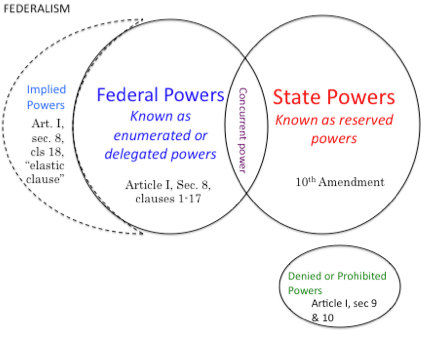
Here's a way to help students visualize the five kinds of powers. (With thanks to my dear friend and former colleague who taught it to me!)

You can start with just the simple Venn diagram below. (Hopefully I'll get these available as a link next week, but honestly, drawing 'em yourself on your Smartboard, whiteboard, or old-fashioned blackboard works just as well. Maybe even better.) Start by going over the delegated powers.


How? Use the text! (Very Common Core, but also just good sense.) Have students go to Article I, section 8, clauses 1-17. They don't have to read every single one, or copy them down in a chart or anything like that. But have them get a sense of some of the things Congress can do, according to the Constitution.  Your students won't understand every word of course. (Neither do I!) But some are easy--even for grade schoolers, e.g. #13- to provide and maintain a Navy or #7, to establish post offices.  I also like to point out #11, to declare war, because that is one that will come a lot when you get to Vietnam. Remind them: ONLY CONGRESS CAN DECLARE WAR. Even if you haven't gone over the fact that the President is commander-in-chief yet, someone will probably bring that up. So you can point out that that is a presidential power and you will get to that when you get to the principle of Separation of Powers and Checks and Balances. But today is Federalism, so back to that.

Then you can discuss State Powers. Of course, these are not listed in the federal constitution, but that's what the 10th Amendment is for. Have students read it. Discuss it. Then ask them for examples of things they know that states do. If they are stuck, give them a hint. Ask, where are you right now? And then they will figure out, oh yeah, school.  And then they will likely come up with other examples. They can do this in groups, in a large discussion format, or whatever works. If they don't figure it out on their own, you can then ask them about things that are listed under Article I, section 8 that both Congress and States do, such as #1: taxes!  This is what goes in the middle of the Venn diagram: the concurrent or shared powers.


Moving along...now you can add a little 
circle to your diagram for the Denied Powers.


You don't have to go over every clause in Article I, sections 9 and 10.  I rarely go into the details, for example, of habeas corpus or bills of attainder. But going over a few are useful. Students know instinctively that neither Congress nor the states can make someone a king or queen or a lord or a duke. And Section 9, clause 8 and Section 10, clause 1 say so. Students can also see that it would be weird if one state could make its own treaty with another country. But you can have them look at that same clause so they can see for themselves. See? Reading the actual Constitution doesn't have to be that hard. High schoolers can do this. Middle schoolers can do this.


So, if it hasn't come up by now, you should now let students know about Implied Powers. Those are "found" in the last clause of Section 8. Number 18--the one you may have told them to ignore for now--is sometimes called "the necessary and proper clause" because it says that Congress can make laws that it deems "necessary and proper" for caring out the powers listed in 1-17. It is also called the Elastic clause because, like elastic, it has the power to "stretch" the powers of Congress.


And the big takeaway from this is...(drum roll)....not all Americans agree about when Congress is stretching things too far. And that, of course, can lead you to all sorts of class discussion, projects, research opportunites about what Congress should and should not do.  (This is also the point where you can explain the terms loose and strict construction.)

But before you do, make sure they get it. So use a historic example.  You can either hand it out on paper or put on a screen, or just go over the scenario below orally.

historic example:
1.    
In the 1790s, the Secretary of the Treasury, Alexander Hamilton, advised Congress to establish a Bank of the United States.  Hamilton believed that because Congress had several important powers related to money and taxes that it was both necessary and proper that the Congress establish the Bank.  However, Thomas Jefferson disagreed.  Jefferson said that because the power to establish such a bank was not specifically given to Congress, that meant that Congress had no constitutional authority to create one.  The Congress did create the Bank.

a.  On what part of the Constitution did Jefferson base his argument?


  ask students-- what delegated powers does Congress 
have that relate to money and taxes? 
Article I, Sec 8, clauses 1, 2, 5 and 18


On what part of the Constitution did Hamilton base his argument? Trick question! Article I, Sec 8, clauses 1, 2, 5 and 18—same ones, just interprets them differently.


Hope this is useful! More ideas on the Constitution coming soon!

Saturday, September 13, 2014

Constitution Day: A Plea about How NOT to Teach the Constitution

UDATE: Here are the posts I have done since this one on the constitution:
post on how to organize a Constitution unit
post on teaching concept of federalism
post on using current events & Constitution to teach federalism
post on teaching concept of representative government
find more here by scrolling to presentation on the Constitution

ORIGINAL POST:
Next Wednesday, the 17th, is Constitution Day.  In Illinois, where I live, there is a law requiring students to pass "an examination" about the principles of representative government as enunciated in the Constitution. (You can see the law itself here. Curious about other states, but not curious enough to google all 50, sorry). Many schools have chosen to administer multiple choice tests to students in 7th or 8th grade, and then again in high school. The Illinois law does NOT stipulate that the examination must be multiple choice, or even that there must be a specific test at all, so there actually is quite a lot of leeway.

It means that, in Illinois, anyway, We, the Teachers, get to write the assessment. It does NOT have to be a memorizingabunchoffactsthatstudentswillpromptlyforgetafterthetest kind of test.

USING THE COMMON CORE
The test we give, and the way we teach the Constitution can be better. Much better. And I think the Common Core can help with that. For example, take this standard:

CCSS.ELA-LITERACY.RH.9-10.4 Determine the meaning of words and phrases as they are used in a text, including vocabulary describing political, social, or economic aspects of history/social science. 


This is for grade 9-10. The middle school equivalent is almost identical; the 11-12th grade standard adds something about how the meaning changes over time, so a good example using the example below might be to discuss how “search & seizure”has changed due to cell phones.


MOVING TOWARDS A BETTER ASSESSMENT FOR THE CONSTITUTION

In my highly unscientific survey, in most schools that I have visited through my work, the students are given a multiple choice test after a unit that teaches the Constitution by going through the three branches, one at a time. Students are asked to "know" things like the qualifications for each branch, how a bill becomes a law (and everyone seems to show the same admittedly adorable Schoolhouse Rock video, "I'm Just a Bill," and what each branch of government does. The way that last point is done is usually by explaining that "Congress makes the laws, the executive enforces them, and the judicial interprets them." I betcha gazillions of kids can recite that back to you perfectly. And they can get a multiple choice question like the one below correct (even if they can't recite it, they will likely get it right, because they all know that when in doubt, the answer is "c").
It is the job of the judicial branch to
a. make the laws
b. enforce the laws
c. interpret the laws
d. all of the above
But do they have any clue what that means? Do they know that Congress can ABSOLUTELY pass a law that might be unconstitutional? How? Because it is not until the Court rules on a case that something might be determined to be unconstitutional. And the Court gets to choose which cases it hears. And which cases it does not. This is a basic--and very important fact--about our system that few kids understand, even after they've successfully crammed and passed the Constitution Test.

And more troubling, rarely are students asked to actually READ the Constitution. Students are told via PowerPoint presentations or through charts in their textbooks that Senators are elected for 6 year terms, instead of reading Article I, section three of the Constitution where this is stated.

Some critics of this approach might go so far to ask, why need to know this at all, in the age of Google, when the answer to how long Senators serve can be looked up on your phone in seconds? It is an excellent question to which I am still formulating an equally good answer. But in the meantime, I think we DO expect our citizens to have a modicum of understanding of how our government works.

The problem is that teaching that in a rote, memorization-sort-of-way is dull, dull, dull.

Let's say that you agree, but for whatever reason, your school or your department chair or whatever really thinks there should be a multiple choice Constitution test. Can't it be a more challenging one, in which students have to actually study and learn something in order to pass? Look, for example, at the question below:
U.S. Senators are elected
a. every two years
b. every four years
c. every six years (again, correct answer--when in doubt--is C)
d. every eight years 

Compare this to the question below. This question asks for the same knowledge, but now students have to apply that knowledge to what they know about members of other branches. Moving up
Bloom's Taxonomy...
Which official must be re-elected most often?
a. Representatives in the U.S. House**
b. the President
c. Senators
d. Supreme Court Justices
What if you changed the question above to a short answer or essay such as this:
Which official--representative, senators, president, or Supreme Court justice--would you consider the most "representative." Explain, making sure to explain what is meant by "representative."
Or this: which official above is the least subject to political pressure? Explain. 

Eventually, we might decide we should totally revamp how we teach the Constitution and offer students opportunities for more authentic assessments/projects. Check out these ideas for student projects. Some of them, admittedly, are way too difficult for middle school students, and many of them are even challenging for high schoolers. You would have to do some scaffolding before you let students loose on these. But think about how much more interesting lessons which led to these kind of assessments could be. Take the first one, in which students do research on some Supreme Court Justice nominees. Finding out about the nomination of Clarence Thomas not only will teach students about the procedure for how a Justice gets on the court, but about the politics involved.

And one last plea....

Once you've taught the Constitution--whether it's a special lesson or two for Constitution Day or a two week unit following the American Revolution, don't just forget about it. Go back to the Constitution often. Revisit it when you teach about the the "fight" between Hamilton and Jefferson about the Bank of the United States. Or Jefferson's decision to purchase the Louisiana Territory. Or about the constitutionality of slavery and the wretching decision made in the Dred Scott case. Or how the federal government used the 14th Amendment primarily as a way to defend corporations until the Civil Rights Movement. Or how the interstate commerce clause was (eventually) used to dismantle segregation. Or when teaching about civil rights in wartime and the Schenk case that arose in World War I. Or Nixon's impeachment and the questions it raised about the power of the Executive branch. Or the stories of how and why various amendments were added to the Constitution. So many more great examples....

There are SO many great Internet resources for you and your students. So until I post more about how to teach the Constitution (I plan to, soon! After the Revolution!), check out these great websites (if you haven't already found them on your own).